
So, what’s going to be in your kitchen?
The traditional pressure cooker – or the Instant Pot?
Both use pressure cooking, which can reduce cooking time and help retain nutrients compared with conventional boiling or simmering.
So:
What’s the difference between a pressure cooker and an Instant Pot, and which one is better in terms of efficiency, safety, and variety of cooking?
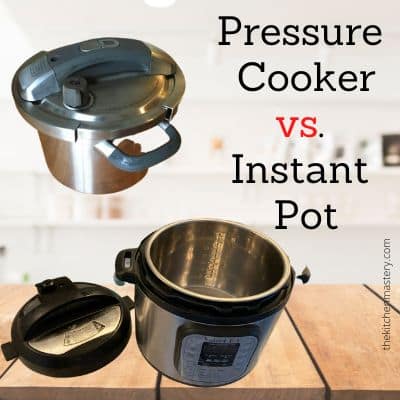
This post contains affiliate links. Find more info in our disclaimer.
An Instant Pot is a brand of electric pressure cooker with multiple cooking modes.
A traditional pressure cooker usually means a stovetop-only pot designed only for pressure cooking.
This comparison focuses on electric Instant Pots vs stovetop pressure cookers.
Instant Pot vs. Pressure Cooker: Key Differences
- Instant Pots are electric, programmable, and multi-function appliances
- Stovetop pressure cookers reach higher pressure and heat faster
- Instant Pots emphasize convenience and built-in safety features, while stovetop models emphasize faster pressure buildup
- Pressure cookers are simpler, faster, and better for experienced cooks
The biggest difference between a traditional pressure cooker and an Instant Pot is the level of pressure that can be reached (most stovetop pressure cookers reach higher pressure levels than electric models), the convenience level (Instant Pot wins), and the multitasking abilities (Instant Pot is better).
Both the Instant Pot and the pressure cooker are closed vessels with a tightly fitting lid that confines the steam until high pressure is generated, raising the boiling point of the water greatly.
Safety valves regulate pressure and release excess steam to prevent unsafe pressure buildup.
An Instant Pot can handle a wide range of everyday cooking tasks in one appliance:
- Pressure cooking
- Slow cooking
- Rice cooking (See the best mini rice cookers for travel!)
- Steaming vegetables
- Saute
- Keep food warm
- Make yogurt
- And with the more advanced models, you can even make cakes, eggs, and spaghetti squash!
You can use the Instant Pot for cooking your breakfast, lunch, and dinner with ease.
You can also use it to prepare components for cold dishes, such as hard-boiled eggs or cooked grains.
On the other hand, a stovetop pressure cooker can only be used for faster cooking of food that takes a long time to cook with conventional methods.
For example, foods like:
- Stews
- Beans & lentils
- Tough cuts of meat
- Squash
- Soup
- Potatoes
- Whole chicken, or homemade stocks.
Cooking Time
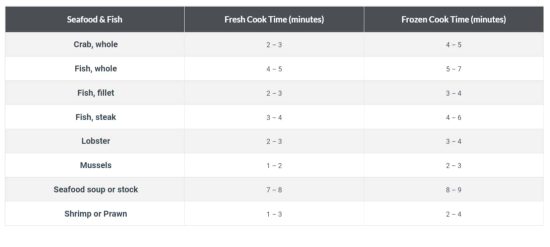
Pressure cookers save a lot of time compared to traditional cookers.
Rice often cooks in just a few minutes once pressure is reached, though total time includes pressurizing and releasing.
Dry beans can take less than 30 minutes.
The Instant Pot is great for busy people with limited time and delivers fast cooking with minimal hands-on effort. Thanks to the multi-cooking abilities, you can cook several meals in less than 30-40 minutes.
Ease of Use
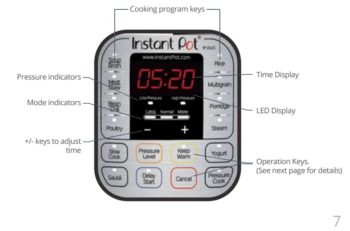
With an Instant Pot (which is a brand name, often confused with electric pressure cookers in general), you can set the cooking time, the timer, and the food type you want to cook. You do not have to watch it constantly the way you have to do with a traditional stovetop pressure cooker.
Also, with a traditional one, you can only choose between low or high pressure.
Also, the inner pot and many lid components are dishwasher-safe, though the heating base is not.
However, when you first look at the Instant Pot manual, you may get a little dizzy.
A lot can be done with it, but it takes time to learn and use all the features optimally. Take it under consideration.
Safety
Modern pressure cooking is significantly safer than older designs.
Instant Pots rely on electronic sensors, lid-locking systems, and automatic pressure release, which reduce user error.
Stovetop pressure cookers rely on mechanical valves and user monitoring, which are safe when used correctly but require more attention.
The Instant Pot inner pot is made up of stainless steel, so it doesn’t flake like conventional non-stick surfaces, which can also be a potential health hazard when ingested.
👉 Bottom Line
In our opinion, the modern, electric pressure cooker, and specifically the Instant Pot, is the superior choice in all terms, including the technology, the accuracy of cooking, the ease of use, and most of all – safety.
Choose an Instant Pot if you:
- Want set-and-forget cooking
- Cook different meals in one appliance
- Prefer built-in safety features
- Have limited kitchen space
Choose a stovetop pressure cooker if you:
- Want the fastest pressure cooking
- Prefer stovetop control
- Already cook confidently with pressure
- Do not need multiple cooking modes
Instant Pot and Pressure Cooker Pros & Cons
Instant Pot: What It’s Best At
- Hands-off cooking for busy households
- One-pot meals with minimal monitoring
- Safer operation for beginners
- Multi-use appliance for small kitchens
Stovetop Pressure Cooker: What It’s Best At
- Faster pressure buildup
- Better browning before pressure cooking
- Fewer electronics to fail
- Preferred by experienced cooks
Best Overall Instant Pot – DUO60 6 Qt 7-in-1
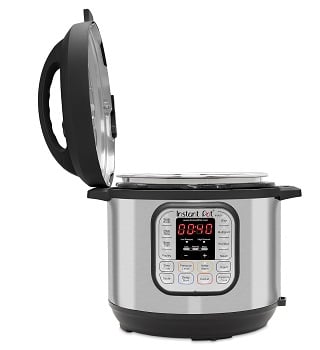
Through our research, the Instant Pot DUO60 6 Qt 7-in-1 is the best Instant Pot model in 2026.
It includes 14 smart preset programs, a 6.5 Quart size/capacity, a stainless steel steaming rack, and 7 functions.
The 7-in-1 Instant Pot can speed up your cooking process by 2-6 times and keeps the food warm for up to 24 hours, thanks to the automatic “keep warm” mode.
Also, it has 12 preset temperatures, which means you can expect some consistent cooking.
It’s not the most versatile model, but it’s the best return for your money and costs 50% less than the newest Ultra 10-in-1.
However, there are only 2 colors to choose from: black and silver.
Best Stovetop Pressure Cooker – Presto 6-Quart
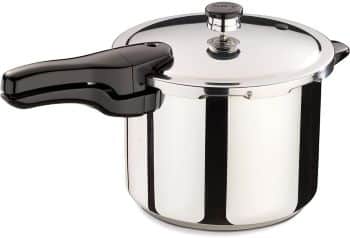
- Best for – Experienced cooks who want speed and simplicity
- Cooking style – Manual stovetop pressure cooking only
- Learning curve – Moderate to high
The Presto stainless-steel stovetop pressure cooker is a durable, easy-to-use pot with a secure locking lid and automatic pressure regulation that speeds up cooking compared with conventional pots.
It works on gas, electric, smooth-top, and induction stovetops, and most of the pot is dishwasher-safe once you remove the sealing ring and pressure plug.
The Top 6 Instant Pot Models
The insanely popular electric pressure cooker – the Instant Pot – comes in 10 available models.
But what’s the difference between the Instant Pots?
We’ve selected the top 6 Instant Pots and reviewed them for you.
1. Instant Pot Duo Evo Plus 9-in-1 Slow Cooker
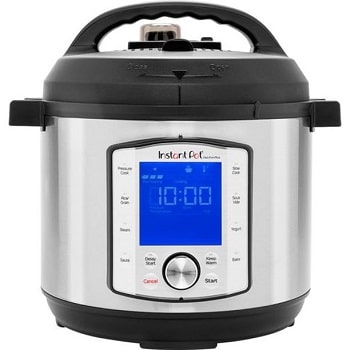
- Best for – Home cooks who want advanced features without going fully “smart.”
- Cooking style – Electric pressure cooking with multiple appliance modes
- Learning curve – Moderate
This best-selling model offers the functionality of 9 different appliances in one powerful electric pressure cooker and cooks any food up to 70% faster. Score!
The Duo Evo 9-in-1 functions as a pressure cooker, slow cooker, rice cooker, yogurt maker, egg cooker, saute, steamer, warmer, and sterilizer, and it makes cake too!
2. Instant Pot 60 Duo Plus 6 Qt 9-in-1
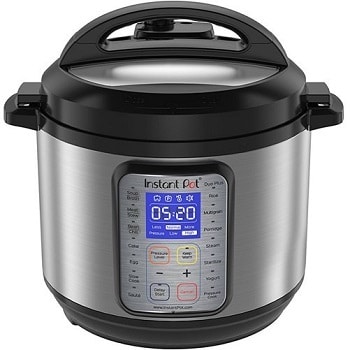
- Best for – Everyday family meals with minimal setup
- Cooking style – Electric pressure cooking with preset programs
- Learning curve – Easy
This model is the upgraded Duo version, which includes the easyseal lid that seals automatically when pressure cooking, and a cooking progress indicator, to let you know when the cooking begins.
The 9 functions are the same as in the first model above.
3. Instant Pot Duo Nova 7-in-1
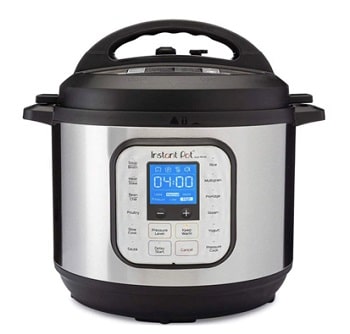
- Best for – Budget-conscious buyers who want reliable core functions
- Cooking style – Electric pressure cooking with simplified controls
- Learning curve – Easy
For a much lower price (and just a little less variety of uses), you can choose this model that comes in 2 different sizes – 3 Qt, 6 Qt (the most popular size), and 8 Qt.
The Duo Nova functions as a pressure cooker, slow cooker, rice cooker, steamer, sauté pan, food warmer, and yogurt maker.
4. Instant Pot Smart WiFi 8-in-1
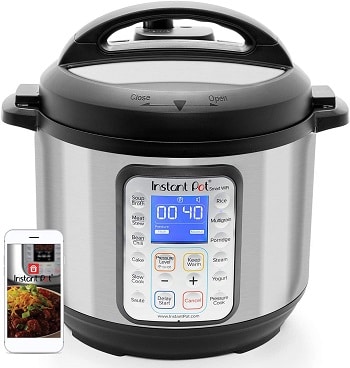
- Best for – Tech-savvy people who like app control and recipe guidance
- Cooking style – Electric pressure cooking with app and voice integration
- Learning curve – Moderate to high
This “smart” Instant Pot is incredibly smart and works with Alexa.
You can add voice control by pairing it with an Alexa device and using the app to access more than 1000 pre-programmed recipes, follow the cooking progress, and receive alerts on your mobile device.
The Smart wifi model functions as a pressure cooker, slow cooker, rice cooker, yogurt maker, cake maker, sauté pan, steamer, and food warmer.
And, it comes with 13 one-touch programs for cooking ribs, soups, beans, rice, poultry, yogurt, desserts, and more.
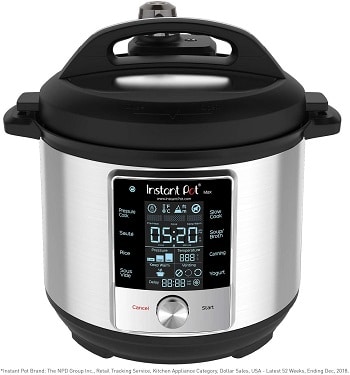
5. Instant Pot Max 9-in-1
- Best for – Advanced users and home canning enthusiasts
- Cooking style: – Electric pressure cooking with precise temp and pressure control
- Learning curve – High
The unique feature of the Max 9-in-1 is that you can use it for home pressure canning!
The large touch screen allows you to set time, temperature (accurate temperature control within +/- 1°C or 1. 8 °F), pressure level, delay start, and Warm.
This is also the safest Instant Pot model, with no less than 13 safety mechanisms.
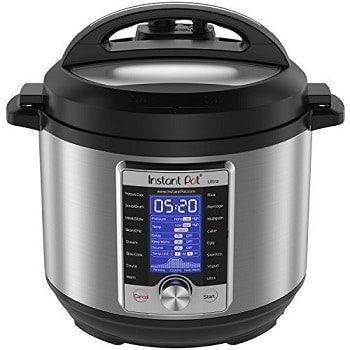
6. Instant Pot Ultra 10-in-1 Best Value
- Best for – Families who want customization and advanced controls
- Cooking style – Electric pressure cooking with manual fine-tuning
- Learning curve – Moderate
This Instant Pot is the next generation of cooking appliances.
It comes with innovative features such as altitude adjustment, a steam release reset button, and a cooking indicator. You can also custom-program it using the Ultra button.
It functions as a pressure cooker, slow cooker, rice/porridge cooker, yogurt maker, cake maker, egg cooker, sauté/searing, steamer, warmer, and sterilizer.
How to Use an Instant Pot
For the beginners out there, here’s a detailed video guide for using the Instant Pot:
Instant Pot vs. Rice Cooker
The main difference between an Instant Pot and a rice cooker is that the Instant Pot is a multi-tasker with many cooking options and abilities, while the rice cooker is supposed to be dedicated to cooking only rice.
If rice is your main use case, a dedicated mini rice cooker may be simpler and more efficient.
Final Thoughts
Instant Pots are better for convenience, safety, and versatility.
Traditional pressure cookers are faster and better for cooks who want manual control.
The better choice depends on how often you cook, how much control you want, and whether you prefer simplicity or automation.
When choosing between the two, we highly recommend the Instant Pot models reviewed above, and especially the cost-effective and best-selling Ultra 10-in-1 model.
The KM Team