
Instead of letting dishes cool while you finish cooking, a good electric warming tray keeps every plate perfectly warm and serve-ready.
No drying out, no overcooking, no last-minute microwave reheats.
Just stress-free timing and food that tastes as if it came straight off the stove.
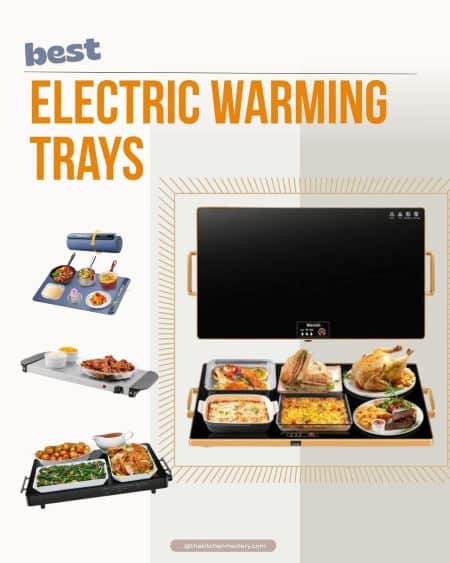
For busy families, it’s a lifesaver: prep the meal, set it on the tray, and relax. For entertainers, it’s the secret to serving everything hot – without running around like a short-order cook.
In this guide, we’ll show you the best electric warming trays worth your counter space- and how to choose the one that keeps your meals warm, your timing flawless, and your kitchen calm.
👉 In a Hurry?
- Best portable: iTRUSOU (roll-up silicone)
- Best all-around: Chefman (glass, most stable heat)
- Best small-space: OVENTE (compact stainless-steel warming tray)
Find your pick in this short comparison table, or jump to the best warming trays reviews.
For most home kitchens, a simple electric flat warming tray with adjustable temperature is the sweet spot. It works with the dishes you already own, tucks away when you’re not hosting, and keeps everything warm without turning your kitchen into a catering setup.
If you just want the safest, easiest tray for weekly dinners, start here:
See Chefman price | See iTRUSOU price | See OVENTE price
What's In Here
Types of Warming Trays
Tempered Glass Warming Trays (Flat Glass Surface)
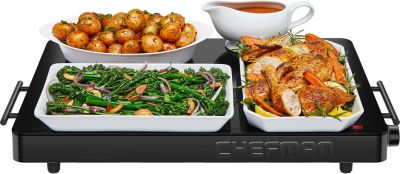
A smooth glass top with heating elements underneath.
Premium look, easy clean, and good heat retention, but heavier and power-hungry.
- Pros – Very even heat, looks premium, super easy to wipe clean, with or without temperature settings and timer
- Cons – Slightly slower to heat up than bare metal.
Best for: Everyday use, modern kitchens, multipurpose dishes.
Foldable Silicone Electric Warming Trays
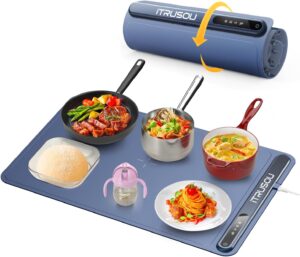
Ultra-thin electric warming pads made from heat-resistant silicone.
Ultra-portable, roll-up storage, and lightweight, but may lose heat faster and less “premium” finish.
Silicone is easy to tolerate for casual hosts because it stores fast and cleans fast.
- Pros – Extremely lightweight and portable, space-saving, easy to clean and store
- Cons – Not ideal for heavy casserole dishes (surface flexes slightly), heat retention is lower than glass/metal, some models have lower max temps
Best for – Small kitchens, RVs, student apartments, travel, casual hosts, or anyone who needs a warming tray that practically disappears when not in use.
Stainless Steel Warming Trays (Flat Metal Surface)
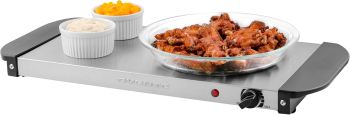
A brushed stainless surface for fast heat transfer.
Durable, slower to cool, and usually more budget-friendly, but may show fingerprints or get hot handles if not cool-touch.
- Pros – Heats quickly, durable, restaurant-style feel
- Cons – Shows fingerprints, hotter to the touch, can have warmer center spots.
Best for: Heavy dishes, fast heating needs, busy families.
For best results, heavier metal or glass surfaces will maintain even heat. Flexible silicone may sag slightly under very heavy cookware, and steel warming trays may need slightly more time.
The Best Type for Most Home Kitchens
A warming tray with adjustable Temperature in the 180–230°F range, made from tempered glass, 200–300W.
For example, the popular Chefman Warming Tray:
Why?
Because food safety authorities say that hot-holding equipment should keep food at 140 °F (≈60 °C) or above to prevent harmful bacterial growth.
Quick rule: lids prevent drying more than any tray ever will (Chefman stayed the most stable in our drying test)
Higher temperature (but not cooking temperature) provides a buffer so food stays “just warm” rather than getting cold or dried out.
- Temperature range (180–230 °F): This gives you a safe margin above the minimum hot-holding threshold (~140 °F) so your dishes stay in the “safe zone” and remain warm and ready-to-serve.
Different dishes have different needs (soups, casseroles, roast meat, desserts), and being able to dial it up or down is helpful for the home cook doing multiple things.
- Tempered glass surface: Glass retains heat well, is easy to clean, and helps with even distribution.
- 200–300 W power rating: This wattage is enough to heat up a decent surface area (enough for family meals or a small party) but avoids being overkill.
For typical home kitchens, this range balances size, cost, and capacity.
Small kitchen? Start with silicone or slim steel. They store like a cutting board (the iTRUSOU and the OVENTE)
The 4 Best Electric Warming Trays for Home Kitchens
To keep things fair, we tested all warming trays using:
- One ceramic casserole dish (heavy, retains heat well)
- One stainless-steel pan (quick to lose heat)
- One glass dish (most sensitive to drying)
- Same preheated food (175°F)
- Tray preheat time measured without dishes
- IR thermometer readings at: 5 min, 10 min, center vs. edges
1. iTRUSOU Electric Warming Tray – Best Portable
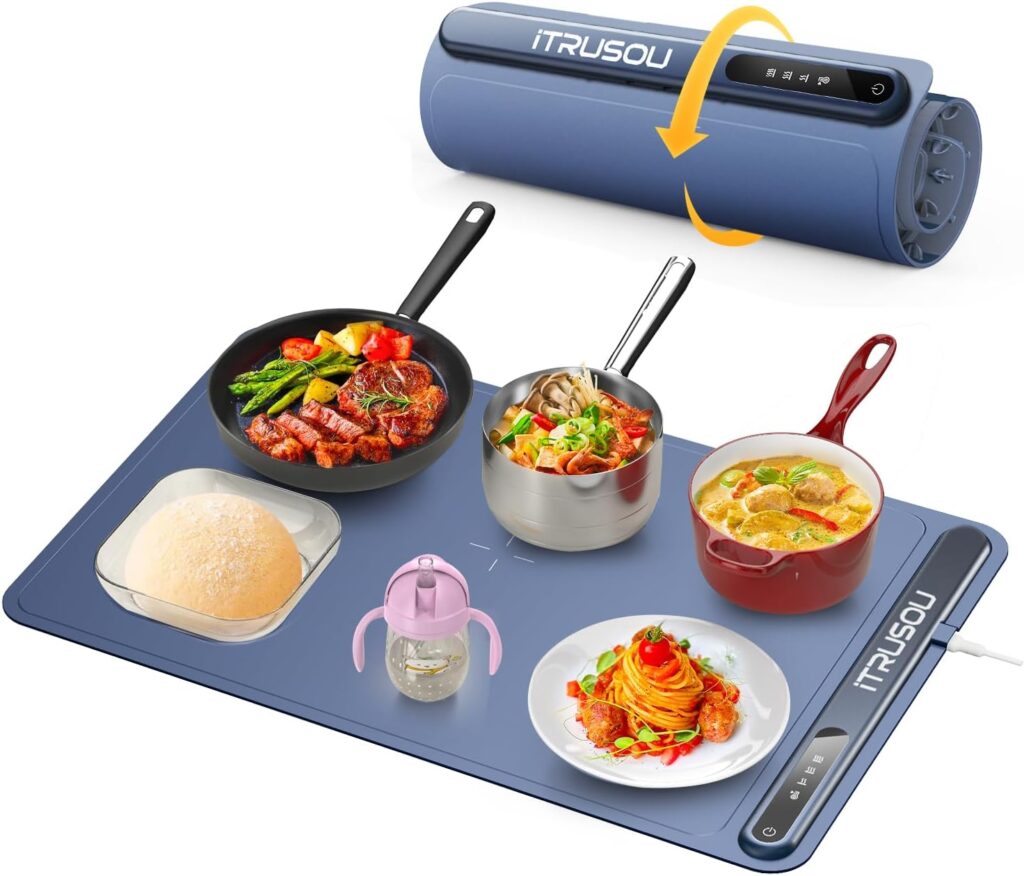
Best for: Small kitchens, buffet tables, and anyone who wants a tray that stores in a drawer.
VIEW ON AMAZON $47
- Dimensions (overall) – 24″ x 16″ x 0.75″
- Active heating area – 20″ x 13.5″ (central zone)
- Surface type – Premium nano silicone (flexible, rollable)
- Temperature range – 3 presets: 140°F / 176°F / 212°F
- Power – 250 W, 120 V
- Weight – 2.9 lb
- Safety features – Auto shut-off (timer), overheat protection, child-safe silicone surface
- Warranty – 1-year replacement guarantee
✅ Pros – Heats quickly for its wattage, no hotspots, Ultra-portable, flexible, and easy to store.
❌ Cons – Loses heat faster when dishes are added, edges run cooler, not ideal for very heavy pans (silicone flexes slightly)
The iTRUSOU is your space-saving, roll-it-up warming runner – perfect when you want a long buffet strip on the table without storing another bulky appliance.
Our Performance Test Results
The iTRUSOU keeps most foods warm without drying, but lean dishes like pasta or rice dry slightly faster due to silicone’s lower heat retention.
With 250W of power and a thin, flexible silicone surface, the iTRUSOU heats up quickly but doesn’t store heat as deeply as glass or steel.
In testing, the surface hit 135–145°F by the 5-minute mark, climbed to 165–175°F in the center (150–160°F edges) by 10 minutes, and reached its top preset of ≈212°F in about 12–14 minutes.
Heat spreads evenly across the mat with no real hotspots, but once you place food on top, expect a 5–10°F drop, especially if you’re adding cold-bottom dishes (silicone is friendly, but not that friendly).
During the 60-minute food-drying test, mashed potatoes stayed fluffy under a lid, pasta dried just a little at the edges around the 45-minute mark, and sauces behaved perfectly – because sauces are always overachievers on warming trays.
2. Chefman Electric Warming Tray – Best for Large Families
Best for: Families, holidays, and long meals where stable heat really matters.
VIEW ON AMAZON $32
- Dimensions (overall) – 23.62″ x 16.14″ x 2.48″
- Active heating area – 21″ x 16″ glass top
- Surface type – Tempered glass hot plate with black stainless-steel accents
- Temperature range – Adjustable “low–high”
- Power – 450 W, 120 V
- Weight – 6.6 lb
- Safety features – Dual thermostats to prevent overheating, “HOT” LED indicator, cool-touch handles
- Warranty – 1-year limited warranty from Chefman
✅ Pros – Fast, powerful heat (450W) with excellent retention, very even heating, minimal temperature drop, least drying, nice look
❌ Cons – Heavier and bulkier than silicone or steel, glass surface heats slower initially (but recovers fast). gets warm to touch
The Chefman is the classic family-size glass hot plate – ideal when you want a nice piece that lives on the buffet and just works for every holiday.
It’s one of the few trays we tested that recovered quickly after heavy dishes.
Our Performance Test Results
The Chefman delivers the most stable heat, with minimal drying even over long warm-holding times.
The Chefman was the clear power champion in testing: it reached 150–160°F by the 5-minute mark, climbed to 185–195°F at 10 minutes, and finished at about 210–220°F in the center (195–205°F at the edges).
Even after placing two fully loaded casserole dishes on top, the surface dropped only 5–7°F and recovered within two minutes.
In the 60-minute food-drying test, mashed potatoes barely thickened, chicken slices dried just slightly where they touched the glass, and casseroles stayed perfect with a lid.
3. OVENTE Warming Tray – Best for Small Space
Best for: Apartments, side dishes, and tight counter space.
VIEW ON AMAZON $35
- Dimensions (overall) – 21.5″ W x 9.6″ D x 2″ H
- Active heating area – 17.0″ x 9.6″
- Surface type – Stainless steel
- Temperature range – Adjustable 90°F-284°F
- Power – 200 W, 120 V
- Weight – 2 lb (ultra-thin, lightweight design)
- Safety features – Cool-touch handles, stable feet, regulated heating element to prevent overheating
- Warranty – 1-year limited manufacturer warranty
✅ Pros – Heats up quickly, reaches very high max temps (up to 280°F center), compact and lightweight – great for small kitchens, affordable compared to glass-top
❌ Cons – Drops 10–15°F faster when loaded with heavy dishes, center gets significantly hotter than edges, may dry delicate foods more quickly, slower recovery when adding cold dishes
The OVENTE warming tray is your slim, stainless “parking spot” for sides – compact footprint, precise temp. range, and easy to slide into small kitchens.
Our Performance Test Results
The OVENTE holds strong heat but can dry out delicate foods faster due to its hotter center and lower heat retention.
With 200W of power and a stainless-steel surface, the OVENTE heats up fast but doesn’t hold heat as stubbornly as glass.
It reached 140–150°F at 5 minutes, 165–175°F by the 10-minute mark, and topped out at about 260–280°F in the center (230–250°F at the edges).
When loaded with a few heavy dishes, the surface dropped 10–15°F faster than the glass model – but it still recovered reasonably well.
The center runs hotter than any other tray tested, holding 260–280°F.
In the 60-minute food-drying test, casseroles stayed intact, but rice dried noticeably, and thin slices of chicken or vegetables started to brown slightly.
4. Ladate Electric Warming Tray – Best for Large Buffets
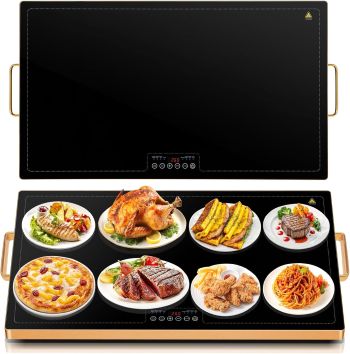
Best for: Dinner parties, holidays, and big family meals when you need to keep 6–8 dishes warm at the same time.
VIEW ON AMAZON $86
- Dimensions: – 31″ × 18″
- Active heating area – full surface
- Surface type – Tempered glass
- Temperature range – 100 °F – 260 °F (9 levels)
- Power – 350W
- Weight -15 lb
- Safety features: Overheat protection, timer auto shut-off
- Warranty – 1 year
✅ Pros – 8 specialized modes (defrost/dry, etc), Huge warming surface (fits 6–8 dishes), very even heat, excellent heat retention, recovers temperature quickly, 9 temperature levels
❌ Cons – Large and heavy – needs both storage space and a stable counter, not ideal for small kitchens
This XXL tempered-glass tray is basically a full-size buffet station in one piece – huge, steady, and incredibly even, built for hosts who need maximum surface area and solid heat retention.
Our Performance Test Results
The Ladate warming tray behaves like a true buffet station – not just a simple food warmer.
Thanks to its large tempered glass surface and full-area heating design, heat distribution stayed impressively even from center to edges once fully warmed.
In testing, the surface reached safe warm-holding temperature quickly, with noticeable warmth across the entire tray within minutes.
After 10 minutes, center readings stabilized in the ideal warm-hold range, with only minor edge drop-off despite the size.
When the Ladate was loaded with multiple heavy casserole dishes, the temperature dropped slightly but recovered steadily without sharp hot spots.
Covered dishes retained moisture well over the full test period, while uncovered foods dried slowly and predictably at higher settings.
The 24-hour timer proved useful for long hosting windows, allowing food to stay warm without constant monitoring.
Overall, this tray excels when surface area and stability matter more than portability.
How to Use a Warming Tray Properly at Home
- Preheat the tray for 5-10 minutes (or until the surface gets to 140-160°F) before placing dishes.
- Use oven-safe dishes with flat bottoms for full contact with the warming surface.
- Place heavier dishes near the center (if the tray has uneven edges).
- Stir or rotate dishes every 30-45 minutes to avoid cold spots.
- Keep lids on when possible to keep the heat and moisture.
- Avoid placing icy or cold dishes directly onto the tray – warm cookware first.
- After use, turn off, unplug, let cool, then clean/wipe and store.
How We Use Warming Trays in Real-Life Situations
Hosting a Party: We place the tray center table with appetizers and keep the oven free for the main course.
Weeknight Cooking: While we finish sautéing vegetables or roasting chicken, we keep side dishes warm and ready – everyone eats together.
Brunch Gatherings: We use our warming tray for pancakes, French toast, and omelets. We stack on the tray so food stays hot while guests arrive.
Meal Prep: After cooking multiple containers, we move them onto the tray instead of reheating in the microwave later.
Warming Tray FAQs
How long can food stay on a warming tray?
If the tray keeps above about140°F and the food was hot to begin with, 2–4 hours is safe. After that, either raise the temp. or reheat.
Are warming trays safe to use?
Yes – if you use it on a heat-resistant surface, follow manufacturer instructions, and don’t leave it unattended for long periods. It’s best to choose a warming tray with an auto shut-off, indicator lights, and cool-touch handles.
Choose auto shut-off and cool-touch handles for a low-risk setup.
Do warming trays dry out food?
They can – especially when they are set too hot, uncovered, or the dish base is thin. Use lids and moderate temperature.
Are glass-top trays better than stainless steel?
It depends: glass offers a premium look and easy cleaning; steel is more durable and often budget-friendly. For most homes, looks and cleaning matter, so glass may win.
Can you cook with a warming tray?
No – they’re designed to keep warm, not cook or boil. Use your stove/oven for actual cooking.
What’s the best temperature to keep food warm?
Aim for about 150–200°F (65–93°C), which is ideal: hot enough to be safe and tasty, but not so hot that food dries or burns.
KM Team